














Your cart is empty!
James Benson-King Pedals the Impossible

In November, James Benson-King will attempt to become the first person to cycle solo and unsupported from the edge of Antarctica to the South Pole. This is a "bikepacking" challenge like no other. Here he runs through the logistics and conditions that make this ride so uniquely difficult. Just reaching the start line is an ultra in itself!

The project is called Pedal The Impossible and will involve covering roughly 1,000km across Antarctica for up to 2 months, with no resupplies or help. In James' own words, it is "the hardest challenge of my life!"
Over to James to talk through everything in more detail:
Pedal the Impossible: My story
I’m James Benson-King, an endurance cyclist and explorer. Between 2022 and 2024 I cycled over 30,000km from Alaska to Argentina. Since then, I’ve raced ultras, trained extensively in cold weather conditions and set a Guinness World Record in India.

Cycling has become my way of challenging limits that I thought were fixed when I was growing up. I was diagnosed with a serious heart condition at the age of 6 and immediately removed from sport. After a successful operation at age 16, I slowly started to trust my body again, and in my mid-20s started to push my limits on the bike.
Despite all the challenges I’ve done previously though, Antarctica is by far the furthest I will have pushed them.
Getting to the start line:
The journey begins on November 11th when I will fly down Punta Arenas, Chile, with all of my expedition equipment and meet with the logistics company enabling the attempt. After checking over all of my gear and final packing, I’ll fly to the logistics base on Antarctica. From there, final safety checks take place whilst we wait for a weather window, and once cleared a smaller aircraft will take me to the official start point. It’s called the Messner start as this is the route Reinhold Messner took in 1989. Once I land I’ll set up camp, complete my final checks and begin the official expedition the following morning.

The route from my start point to the South Pole should be 911km and I’m expecting it will take 57 days, although I’ll carry enough food and fuel for up to 60.
Once that plane takes off behind me though, I’ll be on my own for however long it takes, and carry everything with me I need to survive.
A bike, a pulk (sled) and two months of supplies:
The expedition is built around the Surly Moonlander, a fat bike with 6.2” tires, connected to a pulk (sled) carrying everything I need.
At the beginning of the expedition the pulk will weigh over 130kg. That includes my food, fuel, tent, sleeping system, clothing, stove, repair gear, electronics, filming gear and solar panels!

Each day, I will be eating around 6,500 calories whilst expecting to burn over 8,000. I’ll be melting snow and ice for drinking water and to rehydrate my meals. I’ll be maintaining the bike, managing power through solar panels and setting up my camp spots all whilst battling the extreme cold and difficult weather conditions. I’ll be doing all of this and making every decision completely alone.
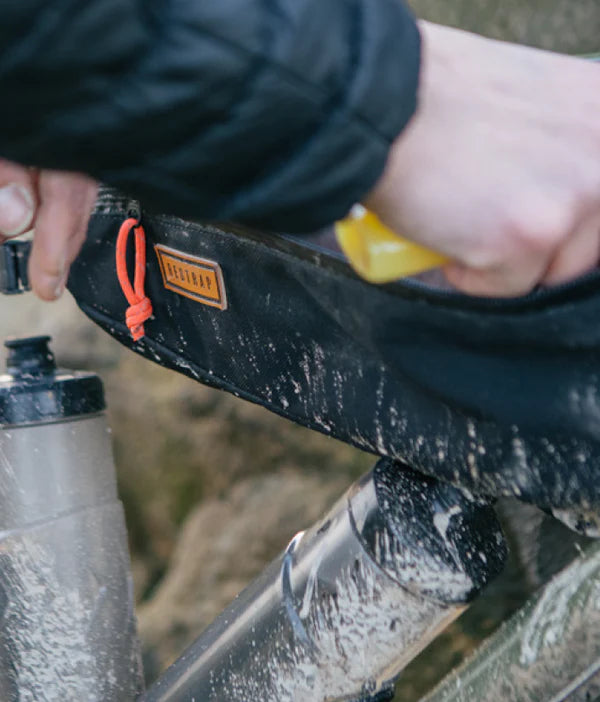
The pulk carries the bulk of the weight but my bike will have equipment I need to use all the time on it. My multi-tools, hourly snacks, GPS, compass and additional gloves, headwear will all be stored in my custom Restrap frame bag. This will allow me to keep it close to me, and not require me to travel backwards and forwards to my pulk constantly! It’s amazing how once the temperatures drops below –30°C everything needs to become streamlined and simple.

This also goes for inside the pulk as well. My food, fuel, camping and repair equipment will all be separated into custom Restrap dry bags. Everything needs a defined place in the pulk to make sure it’s organised and easily grabbed in case the weather gets spicy.
The final build:
In the build up to November, I’ll continue testing and refining the bike and bulk, as well as prepare all of the nutrition and document the build up to the start line.
The attempt itself is solo, but there’s a huge team and support bubble behind it. I couldn’t get the expedition off the ground without the help of family, friends and my expedition partners. They’ve all helped me build a system which I think can conquer the most hostile environment on Earth.

You can follow the final build-up and the expedition itself on my Instagram and Youtube accounts.
As part of this challenge I am also trying to raise over £40,000 for Cardiac Risk in the Young to help screen young people so they can find any heart issues before they become bigger problems. If you’d like to donate and support the link is here.